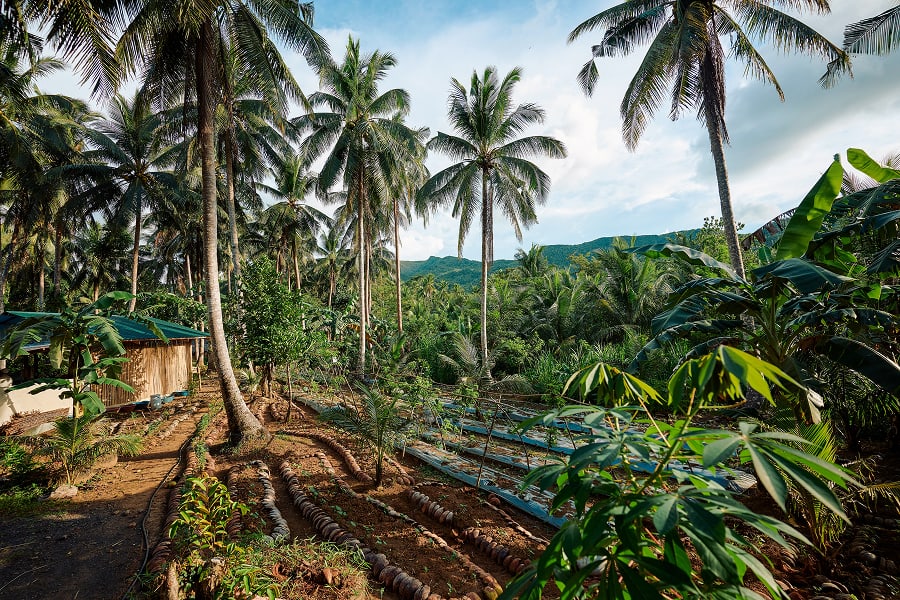
A thud on the ground and the green coconut rolls one or two meters across the damp earth. Elinor Lanuza looks up and squints in the morning sun that is streaming through the palms. She nods to the worker standing beside her. He is holding aloft a ten-meter stick made out of pieces of bamboo inserted one into the other, at the end of which is a sharp knife. “There are three right next to each other there,” says the 55-year-old, pointing to the left. The worker moves the stick to where the farmer indicated. He cuts down the coconuts, which fall to the ground together. Elinor Lanuza picks one up, assessing it. “They are ripe and very high-quality,” she says, and adds it to the pile.
On the two-hectare farm, which Elinor Lanuza runs together with her husband Alen, today is the day of harvesting – as it is for hundreds of thousands of other smallholder farmers in the Philippines. In fact, there are a total of 2.5 million coconut farmers here who have made the Philippines the world’s second largest producer of coconuts behind Indonesia. Elinor and her family live in one of the main cultivation areas, Camarines Norte, around eight hours’ drive by car from the capital Manila.


Challenges on all levels
Elinor and Alen's small plantation is surrounded by a verdant landscape that looks fertile and varied. But things aren’t always what they seem: Many coconut palms are aging trees and bear little fruit, and some areas have not been reforested for decades. Studies conducted across Asia and Pacific by the Sustainable Coconut Partnership show that around 90 percent of the coconut palms are already more than 32 years old and very little new space is being cleared. For the Philippines, this means that on average only 40 to 45 fruits can be harvested from each tree every year according to the Philippine Coconut Authority, just over a third of what the Indonesian trees produce in average.
Moreover, many farmers have limited experience with intercropping and crop diversification, such as cultivating fruits and vegetables alongside coconuts, which could help improve land-use efficiency and product quality, and increase income. They often lack effective strategies to enhance productivity, including proper soil management and ecosystem maintenance, and have restricted access to high-yielding coconut varieties and fertilizers. Furthermore, there is insufficient training to create efficient farming systems, particularly in the face of climate change.
Extreme price volatility also weighs heavily on daily life. The fruit flesh, known as copra, is made into coconut oil, which is dependent on the world market and must compete with other natural oils. Most farms are also less than two hectares in size. Even with average yields, it is barely enough to support a family. “Sometimes we had to choose between buying rice or school materials,” remembers Elinor Lanuza.
Together we support smallholder farmers’ livelihoods, protect biodiversity and climate-resilient cultivation systems, and also ensure long-term raw material sourcing and quality.Dr Isabella Tonaco, Chief Sustainability Officer at Symrise

farmers have been supported by the SDG Coco+ program.
Strengthening sustainable supply chains
500 farmers including Elinor have been supported by the SDG Coco+ program, which Symrise launched in 2020 together with Deutsche Gesellschaft für Internationale Zusammenarbeit (GIZ) Pernod Ricard and Franklin Baker Company of the Philippines. It is part of the Symrise Bridging the Gap (BTG) initiative. “We use this umbrella platform for a portfolio of ground-breaking programs in multiple regions in African, Asian and Latin American countries, to set up actions that have a sustainable impact on the smallholder farmers and the biodiversity while sustaining our supply chains,” explains Dr Isabella Tonaco, Chief Sustainability Officer at Symrise. In Madagascar, India and Brazil, for example, BTG operates as a multi-stakeholder initiative. This includes large brands like Haleon, Natura or The Magnum Ice Cream Company, the Deutsche Gesellschaft für Internationale Zusammenarbeit (GIZ), or non-governmental organizations like Save The Children. “Together we support smallholder farmers’ livelihoods, protect biodiversity and climate-resilient cultivation systems, and also ensure long-term raw material sourcing and quality,” is how Dr Isabella Tonaco describes the objectives of the collaboration.
In Camarines Norte, Symrise is working closely with Franklin Baker that sources coconuts directly from the farmers in the BTG program and processes them in its factory. The fine or medium desiccated coconut is used all over the world in bakeries, cereal bars and ice cream, the concentrated coconut water is utilized for natural flavors for food and beverages. A case in point is the iconic flavor of Malibu, a coconut liqueur from Pernod Ricard that is also a partner in the BTG initiative.
Training for farmers
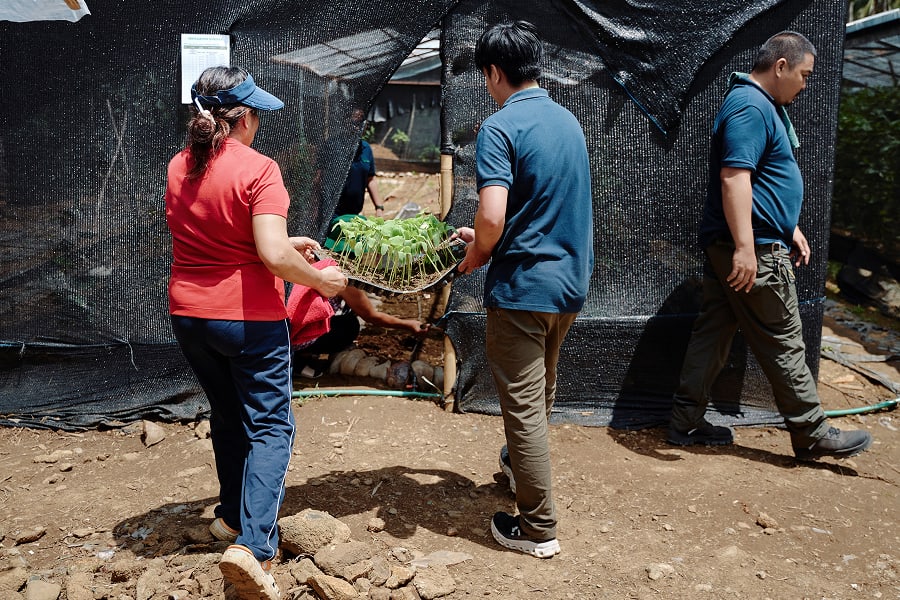
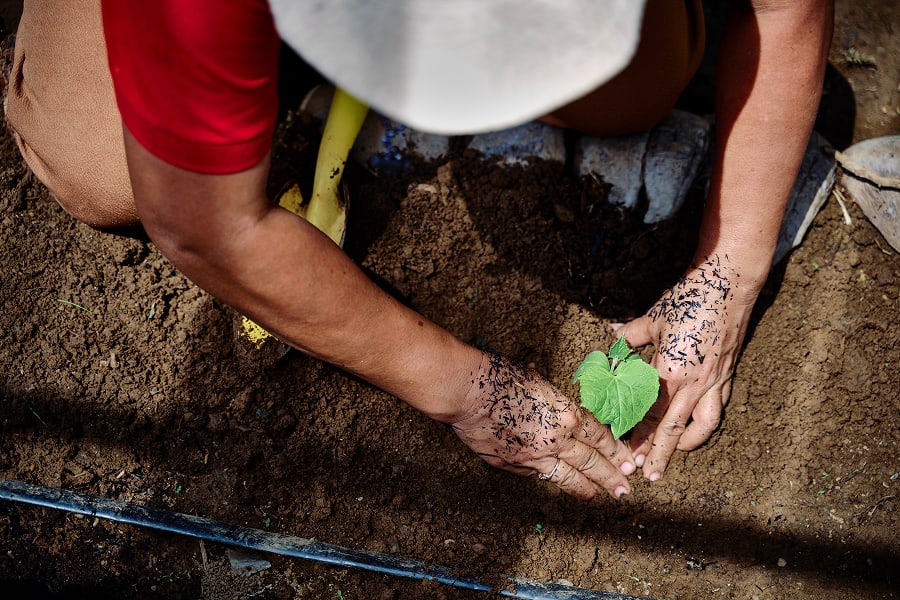
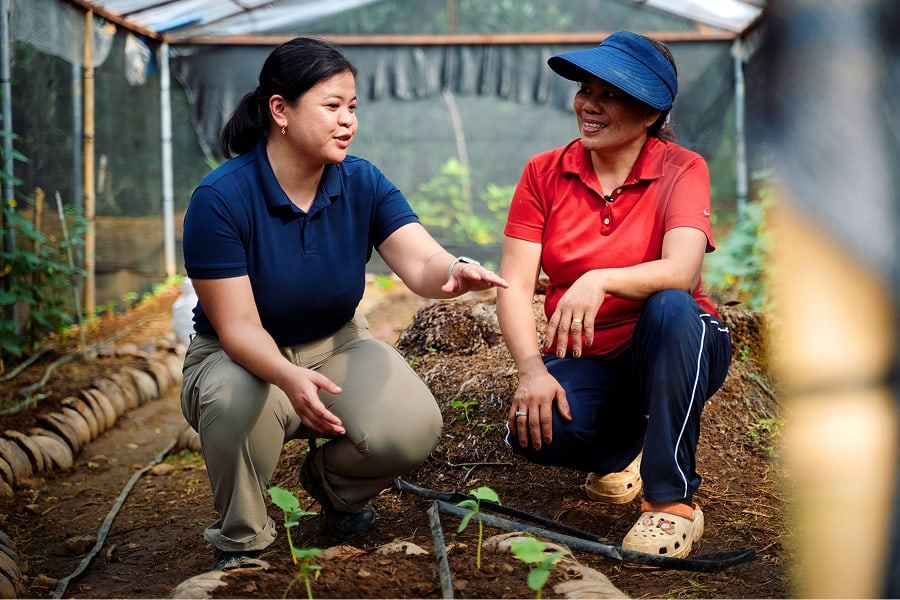
The GIZ also plays a major role, implementing the training and field activities on the ground in the communities. At present, around 500 farmers are benefiting from the program. The transformation is plain to see at Elinor Lanuza’s farm. Where there were only palms before, now there are vegetables and herbs as well as flowering species that attract pollinators, strengthen the ecosystem and promote natural soil fertility. The family also keeps pigs and chickens and has created a fish pond. Waste from the household and the fields is made into compost and dried palm leaves serve as mulch. The soil has changed, becoming darker, moister and healthier. “We now understand that soil is our most valuable asset,” says Elinor Lanuza, whose parents also worked as coconut farmers. “It gives back what we put in.”
Her farm is a prime example of what can happen when a well thought-out program and a committed farmer come together. Elinor Lanuza and her family now also have two small shops selling daily items, and the mother of two runs a demo farm within the BTG program where other farmers can learn how to better prepare for the future.

We want farmers to be more than just good producers. We want them to be entrepreneurs with control over their own future.Patricia Rodriguez, GIZ

Patricia Rodriguez from GIZ is leading the BTG program activities implementation. Today she is explaining to a group of farmers how they can cultivate beets to conserve water and prevent soil erosion. The BTG program team stands in front of a screen and is using a projector to show how to encourage pollinators, protect natural beneficial animals, reduce chemical interventions, etc. Next to her lie training materials that farmers can take with them, from price overviews and simple risk analyses to planning sheets and role plays for the farmers to practice their negotiating skills. “We want farmers to be more than just good producers,” says Patricia Rodriguez. “We want them to be entrepreneurs with control over their own future.” Another important part of a better future comes from the government: The Philippine Coconut Authority has the ambition to help farmers plant over 100 million new coconut palms across the entire country by 2028.
The SDG Coco+ program brings two sides together: companies’ demand for reliable and responsible sourcing, and the needs of farmers, who form the backbone of the value chain while also being particularly vulnerable. The support reaches them directly and helps create prospects for a sustainable future.
A central component here is supply chain traceability and fair practices in line with Fair Trade US standards. This is helped by Franklin Baker only buying whole coconuts and processing them industrially themselves.

Farming to support future generations
In Camarines Norte, the sun sets early at this time of year and the palms cast long shadows. Elinor Lanuza finishes her working day after seeing to the chickens one last time. She is keen to get back to the house and have dinner with her family. The farmer glances at the beets and looks up towards the palms. “Farming is so important to us – it is both our livelihood and our food source. And now we are earning more, which is very good.” She pauses and smiles. “Before, the children here all wanted to leave,” she says. “Today they can see that farming can have a future here too.”
Two phases of sustainable success
Farming is becoming less attractive and less viable in many countries because many farmers’ children do not want to follow in their parents’ footsteps. This increasing generational divide jeopardizes food systems in the long term, particularly in view of the world’s growing population. The Bridging the Gap program wants to change this by equipping farmers with the knowledge, passion and tools to grow, enabling them to reach their full potential as agri-entrepreneurs and improve their quality of life.
In the Philippines, the first phase of the program ran from 2020 to 2024. It had to contend with difficult circumstances as the COVID-19 pandemic severely delayed training and activities. Despite these challenges, the program achieved far more than originally intended. The productivity of coconut farmers increased way beyond the goal of 20 percent, and the families’ incomes outstripped the originally envisaged 15 percent. Many farmers also began to diversify their crops and cultivate new cultures beneath the coconut palms, helping them to mitigate risk and create additional income streams. They also enjoyed improved access to markets, financing options and local government support.

The second phase of the program got underway in March 2025. In this new phase a baseline study has been done allowing to set new targets to increase households’ net income by further 15 percent, while farm productivity should also increase by around 20 percent to keep coconut production stable and meet increasing demand. There is a focus on regenerative farming methods that improve soil health, promote biodiversity and make the farms more resilient to extreme weather conditions. A CO₂ baseline will be established to better understand how current coconut production impacts the climate and will underpin the development of specific plans to reduce emissions. These plans will be drawn up on ten pilot farms. In addition, a study on heat stress exposure has been carried out, and its results will feed into health and safety awareness in farmer training. There will also be further demo farms for farmers to learn about and test regenerative practices for traditional coconut harvesting.
Another focus area will be improving the farmers’ entrepreneurial skills to enable them to better plan their finances, manage risk and open up new distribution channels.